
Connective tissue: building load-bearing capacity
When a muscle is at or near its full length, its fibers aren't in their best position to produce force. At that point, more of the force is carried by the passive connective tissue in and around the muscle and joint: the connective tissue matrix inside the muscle, tendons, and, in a deep stretch, joint capsules and ligaments. At the whole-muscle level, the extracellular matrix carries most of the passive load (Frontiers in Physiology, 2020).
I'm a Beyond Power affiliate. If you buy a Voltra with my link or code TISSUEGUY, I may earn a commission at no extra cost to you. Everything in this guide comes from my own training and programming with the unit.
Why position and contraction type matter
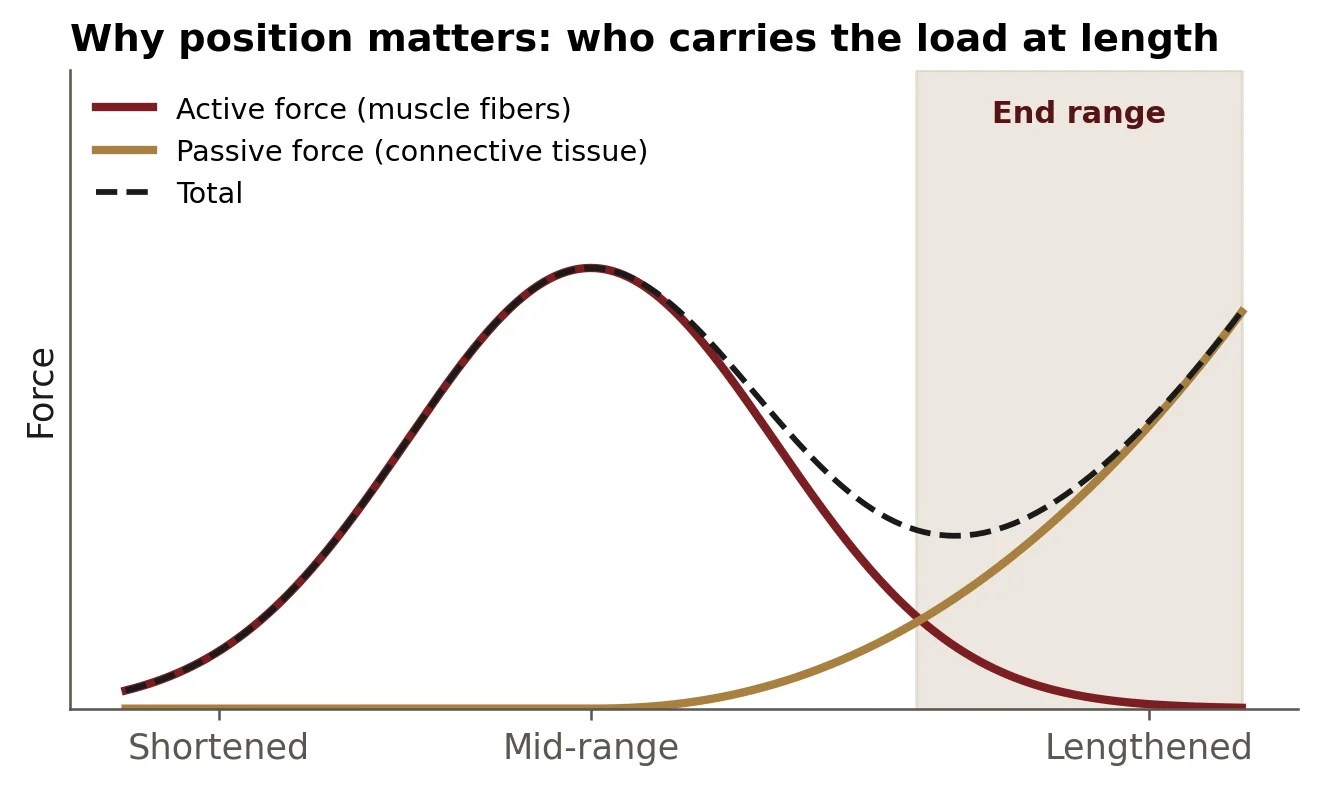
You aren't isolating connective tissue. You're shifting how responsibility is distributed between your tissues, and leaning the adaptation toward connective tissue.
Isometric mode: an immovable object at any cable length
Isometric mode locks the cable wherever you set it. No more building a setup that's exactly the right length to hold the position you want. You also get force data on every effort: peak force, rate of force development, time to peak force and impulse (Beyond Power).
- How I dose it: most of my efforts last 5–30 seconds. True maximal effort fades after about 8–10 seconds, and what I want to know is how much force a tissue can produce in a given position. Tendon research supports short, near-maximal contractions. One well-known protocol uses about 90% of maximal effort, 3-second contractions, 4 reps × 5 sets, and 2 minutes' rest (Arampatzis/Bohm, Frontiers in Physiology, 2020). Longer holds have a place, but they aren't the core of my approach.
- Positions: many positions per joint, each set to the individual (see Principle 3).
- Sequencing: when I pair isometrics with eccentric work on the same day, isometrics come first.
Eccentric neural grooving (my setup)
This is the eccentric overload setup I reach for most for connective tissue.
- Setup: set the concentric load as low as the unit allows (5 lb). Add eccentric load in pounds, using the absolute setting, until the lowering is a real challenge. The percentage setting doesn't work here, because 30% of 5 lb is only 1.5 lb (Beyond Power).
- Tempo: at least 5 seconds per lowering, up to about 8.
- Target: the load-bearing capacity of the tissue being trained.
- Why it works: eccentrics let you expose a tissue to more load at a lower energy cost (PMC review). With the concentric struggle removed, more of your effort goes to the outcome you want (Principle 2). Tendon adaptation is driven mainly by how much load the tissue sees, not by contraction type itself (Bohm et al., 2015). The value here comes from the load you can reach, not from some magic in the lowering phase.
- How the mode works: Eccentric mode uses a pilot rep to estimate where your rep turns over. After that, it drops the load back to your concentric selection on every rep.
Eccentric quasi-isometrics (EQIs)
EQIs are an established method: you hold a yielding isometric until fatigue forces the muscle to lengthen, then keep resisting through the range (SnippitScience; research review, Šport). The intent is to hold the position. You aren't controlling a lowering; you're trying to stop the load from moving you. A single rep can last up to a minute, because the point is to reach failure and let the lengthening happen involuntarily.
There are two ways to run them on the Voltra:
1. Eccentric mode with a high eccentric load.
2. Isokinetic mode at the slowest speed, with the eccentric set higher than you can control. The concentric speed and resistance stay low so they don't drain effort. Here the machine paces the lengthening, and your job is to resist it as hard as you can.
Inverse Chains for connective tissue and joint-based inputs
Inverse Chains load the stretched position hardest and ease off as you shorten (see the hypertrophy section). I use them for connective tissue and joint-based inputs as well as for hypertrophy, typically with 25–60% added resistance at the stretch.